What an Algorithm Actually Is
You’ve heard the word “algorithm” for years, and you’ve also been told that “your data” is valuable. But for most people, both of those ideas are still abstract. They sound important but not fully understood.
So, let’s start simple.
At its core, an algorithm is just a set of instructions for making decisions. If this happens, do that. If something else happens, do something different.
You already use this kind of thinking every day. If it’s cold, you grab a jacket. If traffic looks bad, you take a different route. If a restaurant gives you a good experience, you go back.
That’s an algorithm, simple, predictable, and easy to understand. And if that’s all an algorithm was, none of this would matter very much.
Where That Understanding Breaks
The problem is that real-world systems don’t operate on a few clear signals. They operate on everything at once.
Instead of one input, there are thousands. Instead of one decision, there are layers of decisions happening continuously in the background.
Honestly, even after working in IT for over 30 years, I didn’t think about this deeply for a long time either. It stayed abstract for me as well.
That’s when I decided to make it visual and show what’s actually happening underneath the surface.
Context
In my book, Clarity in a Noisy World: Stop Reacting. Think Clearly in an AI-Driven World - I explain how algorithms and AI affect you at the level of attention, identity, and connection. I didn’t go into deep technical detail there, because that wasn’t the purpose of the book.
This article is different. This is where we look under the hood.
What You’re Looking At
What you’re about to see isn’t one simple system. It’s a layered process built to observe, predict, and adjust your behavior in real time.
Note: This is a very simplified view of a much more complex system. Behind those few boxes are likely hundreds of thousands of lines of code, hundreds to thousands of behavioral inputs, and a constant stream of predictions and decisions being made in real time.
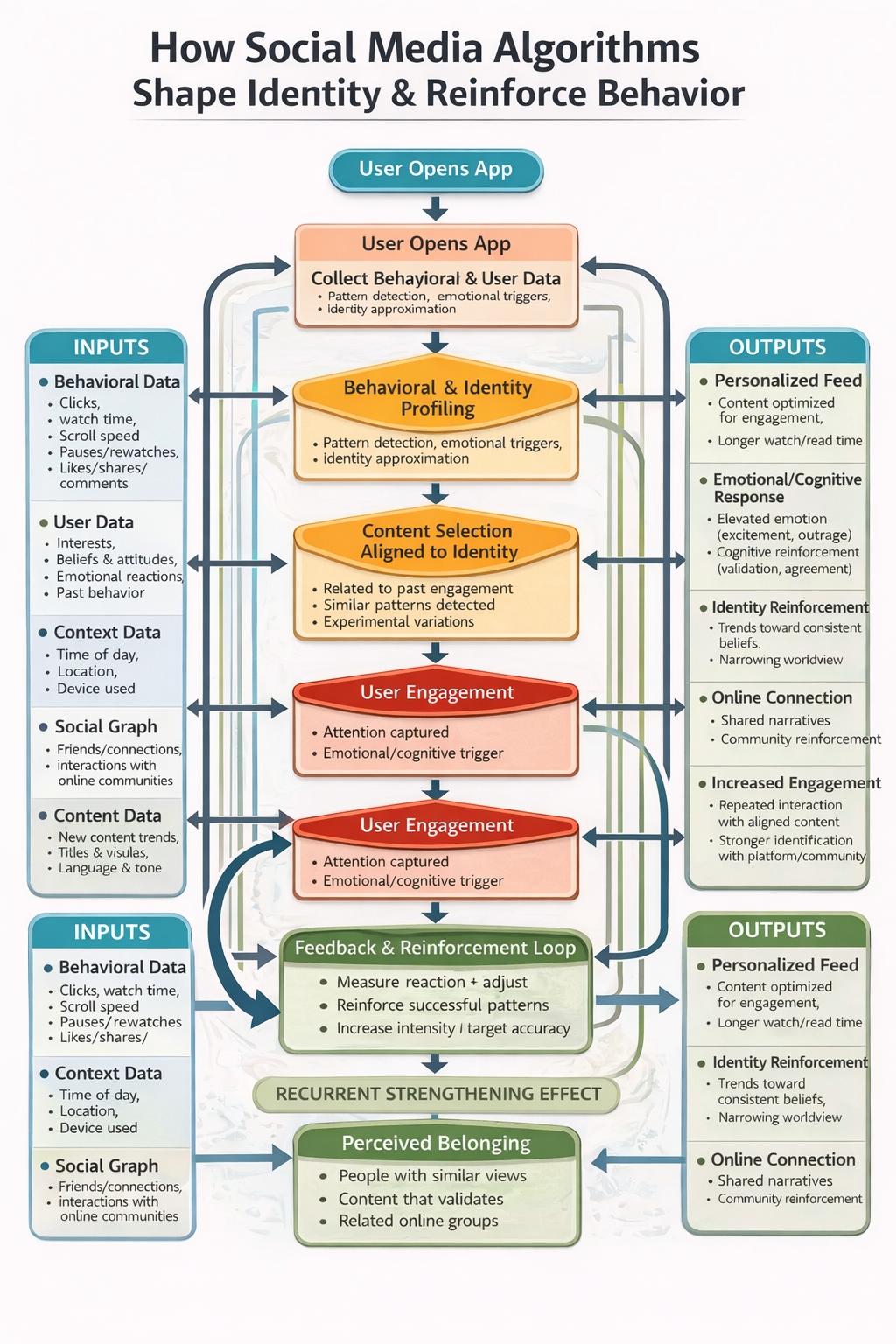
What’s Actually Being Collected
Now zoom in on just one part of that system: behavioral data.
Every click, every pause, every scroll, and every moment you hesitate before moving on is captured, measured, and stored. Each time you go online, you’re not just consuming content, you’re generating data.
In a single session, the system can capture enough detailed behavioral information to fill roughly one full-length, 200-page book about what you did. This isn’t a story; it’s a record of what you paused on, what you skipped, and what held your attention just a little longer than everything else.
And you didn’t choose what got written down. The system did.
That’s one session.
If you do that consistently for a few weeks, you’ve created a bookshelf. Keep going for a few months, and it starts to look like a collection. After a year, it becomes a library filled with detailed records of your behavior, your reactions, and your patterns.
And that library isn’t just sitting there.
Each time you go online, the system is effectively reading from it, using everything it has learned about you to decide what you’re most likely to engage with next. Not perfectly, but well enough to keep you there and well enough to shape what you see.
Over time, the system becomes highly tuned to your behavior, sometimes in ways that are more consistent than your own awareness of it.
It doesn’t need to understand you perfectly. It just needs to understand you well enough to influence what happens next.
What That Data Is Actually Used For
That data isn’t being collected just to sit somewhere. It’s being used, constantly refined, compared, tested, and updated and all of it feeds into one core objective: keeping you engaged.
Attention Comes First
The system learns what stops you; not what you say you like, but what actually holds your attention.
It tracks what you pause on, what you rewatch, and what you almost scroll past but don’t. It tests variations in headlines, tone, and emotional triggers, then quietly adjusts based on what works until it gets better at keeping you there.
Then It Starts Building a Version of You
As those patterns build, something else happens. The system starts forming a model of you; not who you think you are, but who your behavior suggests you are.
It looks at what you consistently engage with, what you ignore, and what you react to emotionally. Over time, those signals get grouped together, and the system begins to form a working assumption about the kind of person you are.
Then It Reinforces That Version
Once that model forms, the system leans into it. It shows you more of what matches that pattern and less of what doesn’t, not as a rigid rule, but as a probability.
Whatever keeps you engaged longer gets prioritized, and over time that creates a feedback loop: you see more of it, you engage more with it, the system becomes more confident, and you end up seeing even more of it.
This Is Where Identity Starts to Shift
At first, it feels like preference. Then it starts to feel like alignment. Eventually, it begins to feel like this is just what you’re interested in.
But that interest didn’t form in isolation. It was shaped, reinforced, and repeated over time.
And Then Comes Connection
The system doesn’t stop at content. It connects you to people who think like you, content that validates you, and communities that reflect your patterns.
And now, AI chatbots have taken that connection to another level, one that is more direct, more responsive, and in many ways, more powerful. Instead of just showing you content or communities, the system can now interact with you in real time, reinforcing patterns, ideas, and perspectives as the conversation unfolds.
That creates something powerful: a sense of belonging. It’s not forced or obvious, but it is consistent, and that consistency matters. The more something feels familiar, the more natural it feels, and the more natural it feels, the less you question it.
The Part Most People Miss
None of this happens in a single moment. It happens gradually and quietly, across thousands of small interactions, each one too minor to notice on its own. But together, they add up.
“What About Staying Anonymous?”
At this point, people often jump to a different idea.
You’ve seen it in movies and TV shows. Someone sitting in a dark room, moving through the internet undetected, completely anonymous, leaving no trace behind.
And yes, there are people who operate at that level.
But realistically, that’s not how most people use the internet.
Achieving that kind of anonymity requires a level of discipline, knowledge, and consistency that most people will never maintain in their day-to-day lives.
What Actually Happens Instead
For most people, the experience looks very different. You’re using the same phone, the same laptop, and the same apps, and you’re logged in more often than not.
Even when you try to limit tracking, using a Virtual Private Network (VPN), opening a private browser window, or avoiding logins, you’re still interacting with the system, and that interaction produces signals.
What you click, what you ignore, how long you stay, and what holds your attention is enough for the system to start learning.
Even Starting “Clean” Doesn’t Stay That Way
If you go out of your way to create a completely clean session, different device, no login, private browsing, the system may start with less context, but it doesn’t stay that way for long.
Within minutes, it begins to pick up patterns in what you’re drawn to, what you skip, and how you engage.
It doesn’t need your name to do that.
It just needs your behavior.
The Reality
You can reduce tracking. You can obscure parts of your identity. But unless you’re operating at a level most people never will, you’re still participating in the same loop.
You engage, the system learns, and the system adjusts, and that process starts almost immediately.
You can make yourself harder to identify, but you can’t stop the system from learning how you behave.
The Bottom Line
That one “book” of data from a single session doesn’t just describe what you did. It feeds a system that is constantly learning what holds your attention, building a model of your behavior, reinforcing patterns over time, and shaping what you see next.
You’re not just using the system.
You’re training it.
And at the same time, it’s training you.